Manual expense management
Manual expense management relies heavily on employees and finance teams to collect, organize, and process expense data by hand. Typically, employees compile a mix of paper, email, and other digital receipts, which are then entered into spreadsheets or accounting systems manually. Human errors often require rework, and business visibility into overall spending is limited.
Automated expense management
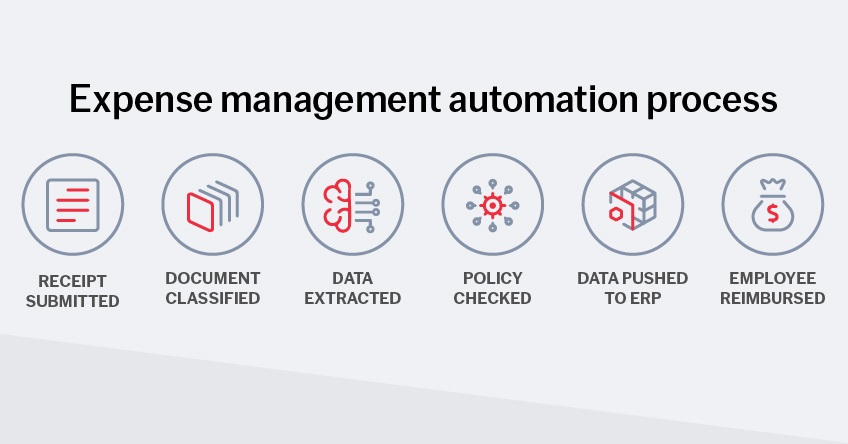
When expense management is automated, AI-driven technology captures, classifies, and validates expense data from receipts and invoices in real time. Key details are automatically extracted from receipts and checked against company policies. Documents are sorted and routed appropriately, and the data flows directly into ERP and accounting systems with minimal human intervention.
How expense management automation helps businesses lower costs
As companies grow and scale, the way they manage expenses needs to evolve with them. Here’s how expense management automation offers businesses a smarter foundation for tracking, approving, and controlling expenses.
Improved accuracy
Humans often make mistakes when handling repetitive tasks. With manual data entry, costly typos and missed fields are common. Automation dramatically reduces that error rate by extracting important data accurately and double-checking them against business rules.
Greater productivity
Automation cuts down the time it takes to collect, process, and approve expenses, so finance teams can handle high volumes of receipts with less effort. Employees are then able to focus more of their time and energy on more strategic work, and businesses can scale without increasing headcount.
Enhanced compliance
Because automation embeds policy checks and business rules directly into the workflow, the risk of policy violations and audit issues is greatly reduced. Some automation solutions also support validation against vendor databases and tax calculations to help maintain regulatory and internal compliance at scale.
Better employee experience
With automation, employee receipts can be captured on the go, submitted in any format, and processed quickly with fewer back-and-forths and faster reimbursement.
Agile expense processes
Expense management needs can change quickly due to new vendors or compliance rules. The best expense management automation solutions can process a wide variety of document types, support multiple languages, and continuously learn from user input to improve over time.
Visibility and control
When expense data is automatically integrated into ERP and accounting systems, businesses gain real-time insight into spending patterns and more accurate forecasting for smarter budgeting.
Smarter and faster: What AI brings to expense management
AI plays a central role in automating every stage of the expense management process, from receipt capture to reimbursement:
- Smart document classification: AI automatically classifies incoming expense documents and assigns them to the correct processing flow, so the right business rules are applied to each receipt.
- Automated data capture: AI-powered optical character recognition (OCR) instantly reads and extracts key information from receipts and invoices, regardless of the format they come into your business. Image preprocessing techniques like auto-cropping, de-skewing, and rotation further improve recognition accuracy.
- Multi-language support: AI models can be trained to process receipts and invoices from a wide range of countries and languages for global scalability.
- Faster approvals: AI technologies apply preconfigured business rules to validate extracted data against internal policies and external sources like vendor databases and tax rules. This allows for straight-through processing for the majority of receipts, only routing exceptions for human review.
- Policy compliance: AI technologies flag out-of-policy expenses and missing information before they reach the finance team. This reduces the risk of fraud or compliance issues and prevents delays with audits.
- Workflow integration: AI-processed data can flow directly into business systems for faster reimbursements and real-time visibility.
- Continuous learning: AI allows expense management systems to improve over time by learning from human-in-the-loop feedback. When users correct or verify data, the AI adapts, increasing accuracy and automation rates in future processing.
The right expense management automation solution combines out-of-the-box functionality with the flexibility to adapt to your business needs. Key features to look for include:
- Ease of setup and use: User-friendly interfaces and built-in support for common document types like receipts, hotel invoices, and taxi fares can help you get started quickly without complex setup.
- Advanced OCR technology: Ensure your platform can accurately extract key data fields from multiple languages and various input formats such as scans, PDFs, and mobile photos.
- Classification capabilities: Your expense management automation solution should be able to detect different types of expense documents and route each to the correct processing flow.
- Security and data privacy: Sensitive financial and personal data must be protected with strong safeguards. Your solution should also be able to apply preconfigured or customizable business rules to catch errors and policy violations before they reach the finance team.
- Transparency and visibility: Make sure your solution connects easily with your existing ERP and other business platforms for real-time data flow and reporting. Clear, timely insights into expense data and processing status will allow you to budget more accurately and prepare for audits.
- Continuous AI learning: Choose a platform that allows for manual review of low-confidence data and learns from corrections. The solution should be able to grow with your business without requiring major reconfiguration, and should improve straight-through processing rates over time.
Why choose ABBYY for automating expense management
For businesses seeking an all-in-one solution that will grow with them into the future, ABBYY Document AI offers both out-of-the-box functionality and the AI-powered flexibility to evolve and scale. ABBYY’s intelligent document processing (IDP) platform lets you:
- Unify expense and payment processes in one scalable platform.
- Process receipts, invoices, and purchase orders (POs) in a single workflow.
- Instantly extract data from receipts without set up or manual entry.
- Achieve high data accuracy that improves continuously with user input.
- Customize workflows or use built-in settings to fit your organization.
- Spot trends, manage budgets, and reimburse employees more efficiently.
- Get real-time visibility, insight, and cash flow control over company spending.
All of this happens with minimal manual effort. Employees simply submit scanned or photographed receipts. From there, ABBYY IDP, customized to your organization’s workflows, takes over, preprocessing photos and scans for maximum quality, detecting receipt fields, verifying totals, checking vendor databases, and calculating taxes. As the system processes more receipts, it gets smarter, learning to recognize vendors and automatically assign expense categories with increasing accuracy.
Watch this four-minute walkthrough of how ABBYY’s expense management automation works to see just how quickly you can get started. For a more tailored look at how ABBYY can automate expense management for your company, get in touch with one of our experts.